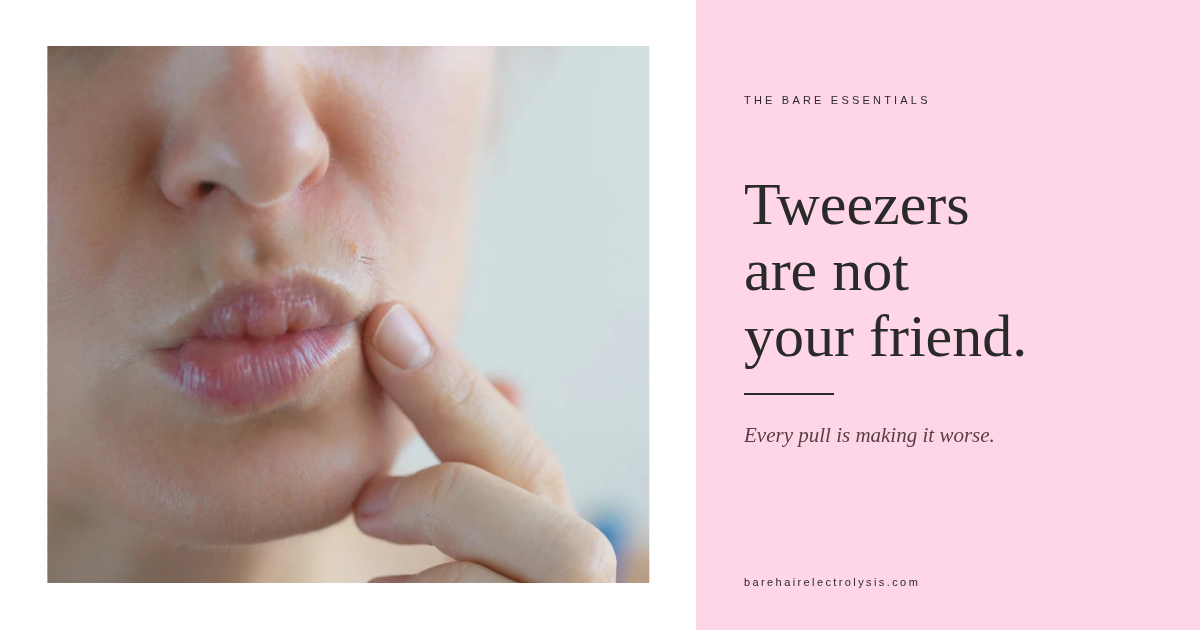
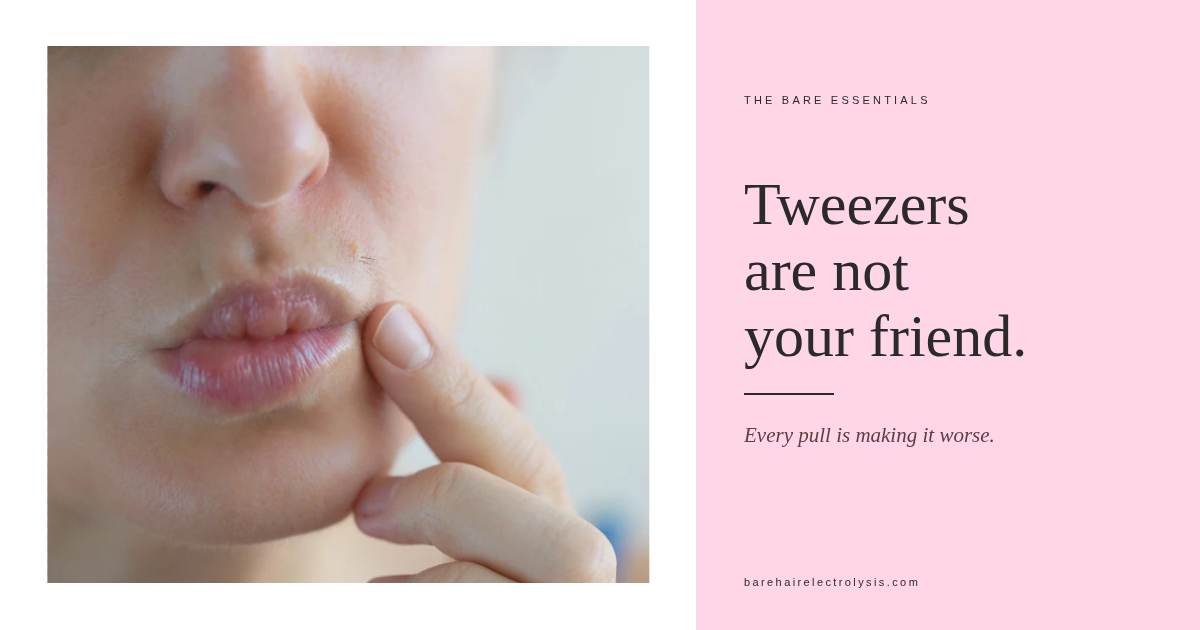
Every tweezer pull feels like a solution. After years of seeing the results up close, I can tell you it's the opposite. Tweezing and waxing don't just maintain hair — they make it coarser, darker, deeper, and harder to remove permanently.
Both tweezing and waxing are forms of epilation — pulling the hair out from the root. Everything I'm about to say about tweezing applies to waxing too. Waxing is arguably worse, because it pulls out every hair in the area, including fine vellus hairs that weren't bothering you to begin with.
What actually happens when you epilate
When you yank a hair out from the root, you damage the follicle. Your body's response is to repair it — and it doesn't repair it back to baseline. It rebuilds it stronger, with a better blood supply than before.
Multiply that by years of tweezing or waxing, and the math is brutal. Hairs that started fine and barely-there end up coarse, dark, deeply rooted, and stubborn.
You're not solving the problem. You're feeding it.
I see this pattern in nearly every new client. They come in with hair that has gotten progressively harder to manage, and there's almost always a long history of tweezing or waxing behind it. I've had clients who started waxing their face years ago and have since developed hair in spots that were completely smooth before. Those fine vellus hairs that nobody could see? Waxing woke them up. Now they're coarse, visible, and need electrolysis to fix.
They thought they were staying ahead of the problem. They were creating one.
The skin damage is real, too
Repeated pulling distorts the follicle. Distorted follicles produce ingrown hairs. Ingrown hairs invite picking. Picking breaks the skin, which lets in bacteria. Bacteria cause infection. Infection causes scarring, hyperpigmentation, and pitting.
It's a cycle, and once you're in it, it accelerates.
This isn't just my opinion
Every standard textbook in the field of electrology says some version of the same thing.
Hinkel and Lind's Electrolysis, Thermolysis and the Blend explains that each tweeze tears out part of the follicle, which then reconstructs itself with a stronger root and a better-developed blood supply. Over years, what was vellus becomes terminal. They're equally direct about waxing, calling it a specialized form of tweezing with the same regrowth pattern, plus the added problem that all the surrounding fine hair gets ripped out alongside the hairs you actually wanted gone.
Sheila Godfrey, in Principles and Practice of Electrical Epilation, makes the same point and adds the part that matters most to electrologists: hairs that have been waxed or tweezed leave behind distorted follicles, which makes permanent removal harder later.
Milady's Hair Removal Techniques puts it plainly: tweezed hair grows back thicker, more pigmented, and faster, and the follicle distortion that results makes electrolysis harder to finish.
This isn't unconventional. The clinical consensus across decades of professional literature is that epilation worsens hair over time and damages skin in the process.
"But I'm just tweezing the same hairs over and over"
A lot of clients believe this, and it's almost never true. What looks like a single hair at the surface is often a small cluster of follicles in roughly the same spot. You're not pulling the same hair; you're pulling new ones from a neighborhood of follicles that keeps producing.
The one exception is when your tweezing technique snaps the hair off below the skin instead of pulling it cleanly. That hair will regrow from the same follicle. It's a broken extraction, and it leads straight into ingrown territory.
What to do instead
Shave or trim. I know shaving feels wrong. There's a myth that it makes hair grow back thicker, and a lot of women specifically don't want to shave their face. But shaving cuts the hair at the surface and leaves the follicle and root completely intact. It does not stimulate growth. It does not make hair coarser. And the intact root is exactly what your electrologist needs to be able to treat that hair at your next appointment.
Stop tweezing. Completely. This is the hard part. Tweezing is a habit, often a daily one, sometimes a compulsive one. Quitting takes real discipline. But it's non-negotiable if you want permanent results. Every tweeze between sessions undoes work and adds to the damage.
Get electrolysis. It's the only method that destroys the follicle itself rather than just removing the hair. Once a follicle is treated, it's done — no rebuilding, no regrowth, no cycle. The hair is released from a dead follicle, and when I lift it out with tweezers afterward, it slides out without resistance. No tearing, no rebuilding, no signal to the body to make the hair come back stronger.
Put the magnifying mirror down
Whatever you're seeing in that mirror... nobody else is seeing! The closer you look, the more urgent everything feels. It isn't urgent. Those hairs will still be there at your next appointment, and we will get them.
What we can't easily reverse is years of epilation damage to your follicles and skin. The sooner you stop, the better your results will be.
The bottom line: Put the tweezers down. Let the hair grow, come in, and let electrolysis end the cycle for good.
Ready to break the cycle? Book a free consultation.
Written by Emily Dalton
Licensed Electrologist · Bare Hair Electrolysis, Riverton UT